Tuesday, 9 July 2013

Gooseberry (Ribes uva-crispa)

AKA: Feaberry, Grozet, Goosegogs

Where: Hedgerows, woodland edges, damp soil. Throughout UK; rare in north Scotland.
What: Berries
When: May – July (early/mid summer)

The Gooseberry is a fairly infrequently encountered hedgerow denizen, but one that is well worth harvesting when stumbled upon. It does not technically grow wild in the UK, despite being ideal conditions for it here, and any that are found in the wild are escapees from domesticated varieties, usually the result of bird theft.

As a shrub, the Gooseberry can grow to 1.5m high, and occasionally taller. It is fairly innocuous in the hedge back, lurking with everything else, but it turns green earlier in the spring than almost everything else around it, which aids in identification. It has smallish broad and lobed leaves, each measuring 4 – 8cm, and which are a dark shiny green above, and a paler green below, with many fine hairs and very prominent veining; the leaves curl inwards in maturity (summer), and vaguely resemble hands. There are numerous very sharp spikes where the leaf meets the stem, and the stem, measuring some 1cm in width, is itself spiny, so some caution is urged when harvesting.

Flowers arrive in mid-spring/early summer, and are tiny, measuring less than 1.0cm, and made up of white petals surrounding a dash of red stamens, and surrounded by 5 sepals of a red-ish colour folded back (often, these are more noticeable than the flower itself).

The fruit, the target of the exercise, is spherical and broadly resembles a grape with a crown of dead sepals. Measuring up to 3cm across, it is a mid to pale green in colour, with clear light green veining and a slightly hairy surface. They taste sweeter the longer you leave them on the ‘vine’, but then, of course you are fighting nature (and other foragers!) for this choice morsel.

They can taste rather tart, so when cooking, add sugar accordingly – I personally prefer them sharp, so I add very little. They taste sort of fruity, white grape-like, subtle, but also large in flavour, with a sour finish. I love them, particularly in tarts, but you can make great sorbet, the classic gooseberry fool, and they go well in crumbles. They really compliment the taste of Elderflower, so creating a cocktail of white rum, Elderflower wine and Gooseberry can be fun! Try them in unexpected places - stuff a fish, make a Gooseberry sauce, or what about a Gooseberry salsa with chilli and garlic?

Gooseberries.

What's Happening?

Spring has sprung, and summer is properly here. The absolutely amazing weather seems to have brought out the best in wild food, and this year looks set to be a bumper crop of all sorts of goodies.

After last year’s dismal effort, the huge quantity of flowers in the spring seems to indicate that this year will be a extraordinary one for Bilberries – the bushes were literally groaning under the weight of the purple flowers, and they are now showing the green immature fruits growing nicely. Here is a description of the Bilberry.

Raspberries are similarly available in a plentiful supply. My usual bushes are not yet ripe – a few more weeks should see them emerge in their delicate glory. Keep checking your hunting grounds as they may be ready now and you don’t want to miss that boat. Here is a description of the Raspberry

Gooseberries! Wow! My local bush was, as of 3 weeks ago, growing nicely and full of life. I checked yesterday, however, and the whole thing was overgrown and all the leaves had been eaten by caterpillars. I did manage to salvage 8 Goooseberries, so not all was lost, but still, I’m not impressed! Next year I will do some weeding… or does that count as gardening rather than foraging? See post below for the details on Gooseberries. 

And ladies and gentlemen, the whole house once again smells of cat pee which can mean only one thing, the Elderflowers are in season. Get them whilst the going’s good… or not! They really seem to be everywhere this year, and one can smell them in the most unlikely places. Kate is making champagne again, but also a cordial, and is attempting to make a wine. We have a freezer full of the flowers too, so that should keep us going for a while! Recipe and description are here and here.

In other interesting news, I discovered a Medlar tree on my travels yesterday. I had thought the tree looked familiar when I first came across it in the spring, but I couldn’t place it. So, during yesterday evening’s ramble, I explored further and lo, the large leaves and the small emerging apple-like fruit gave it away. Here is a description of the Medlar. 

Elderflowers in full bloom.  
What was left of my Goosberry bush after the caterpillars!


Wednesday, 26 June 2013

Jack By The Hedge (Alliaria petiolata)


AKA Garlic Mustard, Hedge Garlic, Jack In The Hedge, Sauce Alone, Poor Man’s Mustard

Where: Shaded hedgerows, field and especially woodland edges. Throughout UK except Scotland
What: Leaf, Seeds
When: Leaf: spring and occasionally autumn. Seeds: August/September

This is an excellent, and thankfully common, plant with bags of flavour. Growing on a single, thick (up to 2cm), and hairless dark green stem, the plant can reach up to 1m in height. It produces numerous bright or yellowish green leaves – pointed in the upper part of the plant, and more rounded or kidney-shaped with rounded lobes and growing in a rosette in the lower part. The leaves are 3-7cm long, with deep veins running over the surface and with a sharply rounded toothed edge. The whole looks not to dissimilar to the Nettle (Urtica dioica) but the surface is completely hairless, and crucially, the leaves smell subtly of garlic when crushed. Interestingly, the plant is a biennial, and so if the autumn is warm and good, then a second crop of leaves may appear in September or October.

The delicate white flowers, made up of 4 petals and measuring just 7mm across, arrive April to June in small clusters at the top of the plant.

The seeds occur in summer in thin, four-sided, upright pods, each measuring 5cm and maturing to a greyish brown colour, and containing two rows of little black seeds 2.5mm long. The seeds can be crushed with oil to make a very nice wild mustard, or can be used as a flavouring for cooking.

Taste: both sets of leaves are good to eat, but the upper, pointier, versions are the better, I think. Tasting of garlic and mild mustard, but not overpoweringly so, they are excellent in a salad, or as a green. Try them in an omelette or cook with them, perhaps laid over a fish. I have made a rather good soup with the leaves, lentils, tomato and stilton. 


                                  Jack By The Hedge in early June.


                                      The Flowers in early June


                                        The leaves in early June      


Sunday, 9 June 2013

Ey Up! We're Back!

Spring is once more here! 
With renewed vigour, we at The Forager's Guide will be updating this blog often and with great ideas and foragable food descriptions! 

We went for a walk this afternoon, just up the hill from the house and along the trackway above Glossop. I have to say, after last years marked dearth of Bilberries, given the number of flowers we saw on bushes, this year will be a bumper crop... bring it on!

Right now though, Kate is cooking a chickpea and potato curry, and I'm drinking a Strawberry, Apple and Grape wine we made last autumn from some 'reduced' fruit from Tesco and the last of the Wild Apples we foraged and which had started to go soft. I think I have the best of this deal! Cheers folks.  

Wednesday, 29 August 2012

Plum (Prunus domestica, etc.)


AKA Greengage, Bullace, Damson, Cherry Plum

Where: Woodland Edges, hedgerows. Throughout UK, but more common in south.  
What: Fruit
When: September – November

The Plum – fantastic fruits, versatile, and often occurring in huge quantities on single trees, they can be used 1000s of recipes, as well as being preserved for later use.

Now, there are dozens of inter-related species that come under the heading Plum, but for the UK, and our purposes of ‘wild food’, we will be dealing with the Greengage (Prunus domestica ssp. italica) - which is rarely found outside of gardens, but which can very easily escape, and the Damson (Prunus domestica ssp. institia) otherwise known as the Bullace, as well as the true Wild Plum (Prunus domestica). Also included here is the Cherry Plum (Prunus cerasifera) which differs very slightly, although there is no real difference in terms of the fruit. However, for the sake of simplicity (and at the risk of annoying plum fanatics the world over) I shall treat them as a single plant species, whilst noting any significant differences so that you can at least identify the species on which you are chomping.

Growing as a small tree (max. 9m) or shrub, the varieties of plum occur mainly on woodland edges and in hedgerows, and often near habitation (as escaped cultivars).

The pointed oval leaves appear alternately on the stem in spring time, often after the blossom has arrived, and measure a maximum of 6cm by 3cm with fine toothed edges. They are ribbed with a slightly hairy underside, and are a dark matt green in colour, though often by fruiting season they become a mottled yellowish and/or brown-red flecked in places.  The bark is a grey brown in colour, and smooth at first, though becoming cracked with age, and whilst most species are thornless, some aren’t, so check before climbing about.

The flowers occur in April/May time, though much earlier with the Cherry Plum tree, typically in March/April. They are a typical tree blossom: made up of 5 delicate white petals with a yellow centre, and measuring 2.5cm across, they occur singly, or in groups of up to 3, sometimes in huge quantities giving an explosion of white amongst the spring greens.

Now, the fruit. For most Plum trees, they arrive in September, and last into October, however, the Cherry Plum, comes much earlier, usually in July. They are typically smaller than cultivated varieties – usually about 6cm give or take – and are an oval or round shape, with the characteristic groove down the side. It has many different colours ranging from the classic dark purple plum colour, through red, yellow or green, an every combination in between. The skin is peeled to reveal a yellowish flesh that can either be quite tough or very soft, depending entirely on tree, variety, ripeness, etc. Similarly, they can be beautifully sweet and juicy, or horrifically astringent and sour – there is no way of knowing without trying; each tree will be uniformly of the same taste, so my advice is if you find a ‘good’ tree, stick with it, although you will be fighting birds, and other foragers for its bounty. All Plum trees, but especially the Cherry Plum, can produce a mass of fruit in great bunches so that they resemble vines laden with grapes, and will often break branches under their weight. Happy hunting!

What to do with them once you have collected them? Well, they make good eating on their own – as you would a normal plum. You could dry them completely in the oven or dry breezy place as one does with apple, etc, and eat them like that or add them to cakes, breads, scones, etc. Or you could partly dry them and add to a syrup to make prunes - love ‘em or hate ‘em, they will keep you regular! I have a recipe for a plum curry which I’m dying to try – it will either be amazing or… well, I dread to think! And of course, there is the ubiquitous wines and gins to try and make. Of course, the classic way of enjoying them is stewed in a pudding, or, even better, as a Damson jam. A big regret of mine is that I never got my Nan’s recipe for Damson jam – all I remember is that it was sweet, big on flavour, thick, and had huge lumps of Damson in it. Let that be an object lesson for you all – get the family recipes whilst you still can, for once they are gone, they are gone forever.


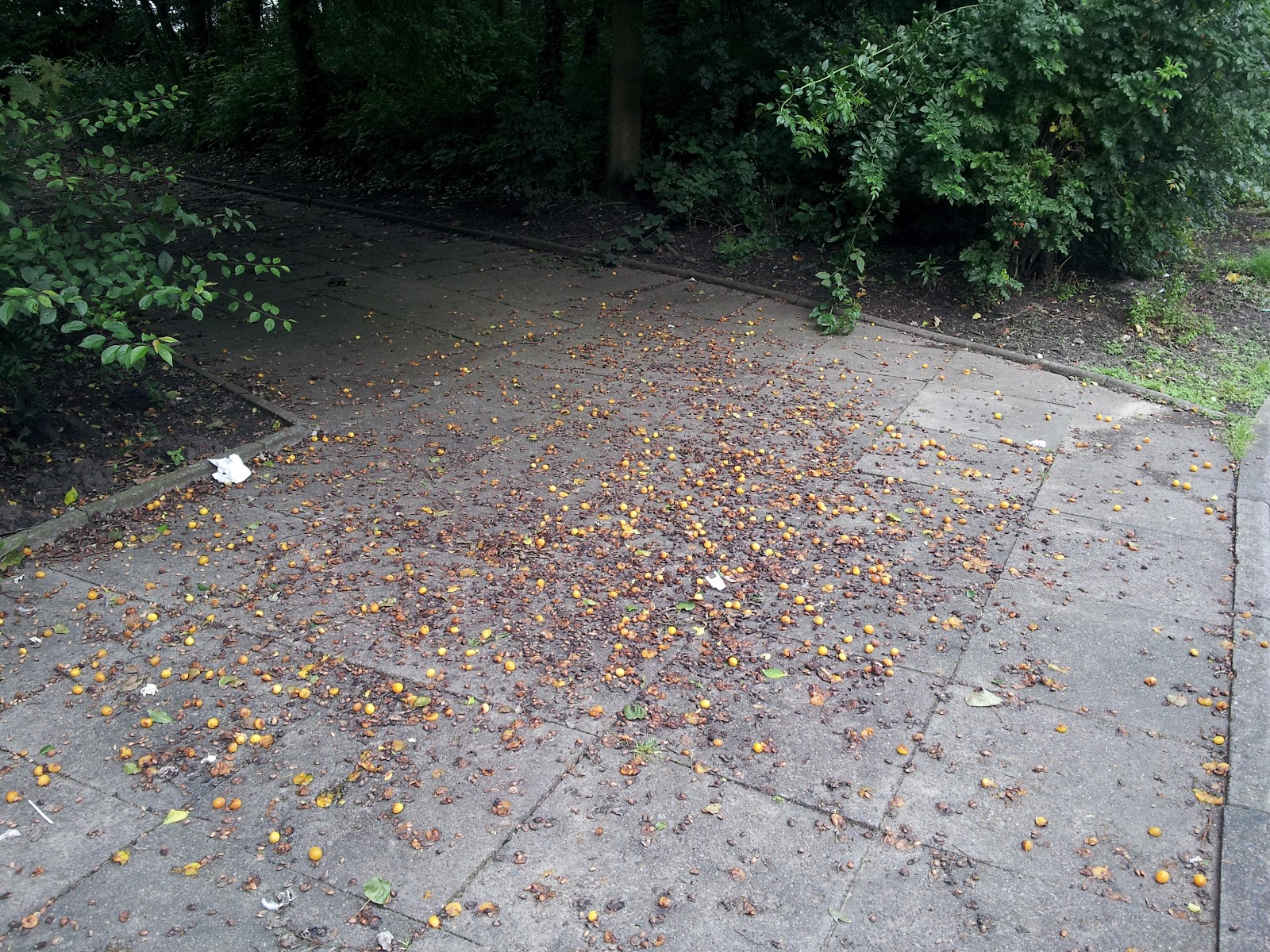
The mess below the tree - often a great way of identifying Plum trees!


Bilberry (Vaccinium myrtillus)


AKA: Wimberry, Blaeberry, Whortleberry, Huckleberry, Blueberry.

Where: Hilly areas, moorland, covering areas of heath - prefers acid soils. Particularly in North.
What: Berries only
When: July – September, occasionally later

The Bilberry. Ah, the Bilberry. What can we say about this shiny black berry. It is definitely my favourite fruit and I have great childhood memories of picking Bilberries in the hills above Macclesfield with my family. It is a relative of the larger North American Blueberry, but is superior in every way, especially flavour, and is criminally underused as a fruit, being relatively unheard of despite being relatively common – I still have people, smart worldly people, pull a blank face when I mention the Bilberry.

The Bilberry prefers acid soil and the hillsides and peaks of sandstone areas, and are much more common in the north and midlands, and especially in the Peak District and Cheshire Pennines where the environment is perfect. The bush is low, measuring up to a maximum of 70cm, and whilst can occur in isolated patches, is usually to be found in vast swathes. 

The leaf is small, measuring up to 1cm, pointed oval in shape with a slightly toothed edge, and is a mid green with occasional brown or black dots, quite thick, and has a prominent mid-rib. Taken as a whole, the plant is quite straggly looking and somewhat sparse, being tough and wiry like heather, with which it shares the same environment, and has thick brown stems, and green twiggy new growth with reddening tips.

The small (<1cm) delicate flowers arrive in spring (April/May) and are a pink, white, and purple mix, and, hanging down, they resemble lamps, drooping with a central dark stamen. These disappear by June, when the berries appear. Starting small and red, but gradually growing to 1cm and darkening to a shiny deep purple with a whitish bloom and a prominent calyx by late July/August, they resemble small blueberries of the kind you can buy in supermarkets. Although they are an autumn fruit, I have picked them in mid December before now, so keep checking your areas. Taste wise – oh man! Fruity, but with a depth, subtle and deep sweet, but also tart! Just pop a few into your mouth and taste for yourselves, but be warned their purple juice stains like nothing else… it’s like being tattooed! They are great in tarts and pies (a favourite of mine), as a jam, they make great sorbets and fantastic wines.

People often complain about the amount of work that goes into picking the Bilberry – a lot of effort for little gain. I say rubbish! You are not finding the good bushes! Keep looking, and you will find the ones that are literally dripping with fruit. That’s no to say that picking isn’t backbreaking at times. There are Bilberry pickers – like combs with a collecting box underneath – but you end up losing more than you collect, which seems incredibly wasteful. No, far better to grin and bear the back pain… it will make you appreciate the wondrous bounty all the more!


Dog Rose (Rosa canina, etc.)

DOG ROSE (Rosa canina)
AKA Wild Rose, Briar Rose, Dogberry, Sweet Briar.

Where: Hedgerows, especially in woodland and wasteground. Throughout the UK
What: Petals, Hips.
When: Petals = May – July. Hips = August – November, potentially later. 

Roses have come and are now going, leaving behind Rose Hips of all shapes. These are to be seen all over (especially the large Japanese Rose) and all are edible.

Also included in this section are the less common Field Rose (Rosa arvensis) and Japanese Rose (Rosa rugosa). There are many varieties of Wild Rose throughout the UK, all of which conform to the same basic description, and all of which are suitable for our needs, but the Dog Rose is probably the most commonly encountered.

Often lurking within a hedgerow, mingled with other hedge dwellers, the Rose sits fairly innocuously until spring when it bursts into life with the flowers for which it is justly famous. Growing to a height of 1.5m, but can be larger, it drapes itself over the surrounding plants and trees with a long trail coming from a thick central stem, both hard and covered in sharp hooked thorns.

The leaves of the Dog Rose are oval to a point with a finely serrated edge, bright green upper and pale green underneath, and measure up to 3cm in length.

The flowers begin to show in May and becomes common in June to August  and are made from 5 petals. In both the Dog Rose and the Field Rose, the flowers are white with pink tinged edges and yellow stamens in the middle and up to 2cm wide, the Japanese Rose is a dark pink to purple with a pale purple centre and are slightly larger (up to 3cm). The petals are very delicate, especialy from July onwards, and can be gathered with just a tap. Add them to salads or ice cream for a delicate aroma, or they can also be made into rose petal water, or even Turkish Delight.

From August onwards, following the shedding of the petals, the hips grow from the remains of the flowers, leaving a crown on top of the brigt red bulbous fruit. Up to 4cm long, and oval or rounded in shape, they are very difficult to miss in the Autumnal hedgerow, and can last until Christmas, although by this time they become slightly dog-eared and tired looking. Beware of the small, and very sharp, spur that lurks beneath the leaves by the hip. The hip itself is fairly soft and when split reveals a hollow filled many seeds and covered in tiny hairs. A word of caution; these hairs are a powerful irritant and need to be removed before the hip can be eaten. This can be done on an individual basis, individually, simply scraping out the centre, thus leaving the hip intact to be used as a fruit proper, or more efficiently by boiling and mashing the hips. Rose hips contain more Vitamin C than any other native plant, as well as truck loads of other really good vitamins and minerals, and werer recommended by the Ministry of Health during WWII as a way of combating concerns about scurvey. The main, and most famous, use for the hips is the delicately flavoured Rose Hip Syrup, but they do have other uses – pies for example, or used with other fruits in a variety of different ways. Note that the Japanese Rose hips are much larger than those of the Dog or Field Roses, and consequently produce larger yields of fruit.

Lookalikes: Nothing that is easily confused with the Dog Rose, although certain ornamental flowers can have berries that are superficaly similar to hips. As always, just make certain of the identification.


Medlars!


So, some friends of ours have a Medlar tree in their garden – lucky them! They live in the wilds of Lancashire (Wigan to be precise), and inherited the tree from the previous residents. Interestingly, it had been grafted onto a Hawthorn tree at some stage, rather than grown as a tree in its own right, so someone had really, really, wanted Medlars! Anyway, as they are quite uncommon, here is some information about Medlars. Thanks Joy and John.

Medlar (Mespilu germanica)


Where: Woodland edges, hedgerows, sunny hillsides. Mainly in south.
What: Fruit
When: October – December

The Medlar, like the Quince, is one of the lesser known fruits due to its relative rarity growing both in the wild and as a cultivar. Once widely consumed by all and considered a delicacy (Shakespeare mentions the fruit), it is now confined to ‘those in the know’… and now you!

Growing either as a tree proper, or more commonly in the UK, rambling shrub, the Medlar can reach the height of 6m, though usually 4m or thereabouts. The leaves grow alternately on thorny branches, measure up to 12cm (occasionally more) in length, and up to 4cm wide, and are a relatively narrow long, spear-shaped, elipse in shape. They have a finely toothed edge and are a light green colour, with greenish brown ribs and veins and a lighter, downy, underside.

The bark is a greyish brown, with erratic vertical fissures and large flakes, not unlike that of the Wild Service Tree. The flowers occur in May and June, measuring up to 3 cm across, and usually shorter than the green sepals underneath, they are made up of 5 white petals with a yellow centre.

The fruit, whilst occurring in August, is edible from October onwards, and is brown to reddish brown in colour with a rough, slightly hairy, skin. It has a flat top with a crown made of the green sepals below the flower. The flesh is not unlike a hard apple, and contains 5 seeds measuring c. 1cm in length. Because they are not a native to this country, though they are naturalised, the fruit does not get a chance to ripen properly, and whilst they can be eaten when they are unripe, they are best picked and consumed once they have started to rot on or off the tree – ‘bletted’ is the correct term – usually after the first frosts in November onwards – keep an eye on them until they become soft and edible

The unripe, or unbletted, Medlar tastes sharp and astringent, and has a distinct sweet apply flavour. However, it is with the fully bletted fruit that you can appreciate the flavours – subtle and certainly unique, it is not unlike a sweet apple mixed with caramel, with hints of spices (cinnamon?) and a sharp taste. Look, just try it will you! People do say it’s an acquired taste, but I love it.

I spend a lot of time working on the island of Crete where the Medlar is a delicacy and is known as μούσμουλο (Musmulo) – the word itself is Turkish and is a hangover from the Ottoman occupation of Greece. And whilst we are on the subject of etymology, it was in cruder times, once known as ‘open arse’ – for obvious reasons – and its welsh name ‘afal tinagored’ means the same, whilst the French name, 'cul de chien', means dog’s arse. So now you know.

Enough arsing about, and onto the recipes. It makes a great jam/jelly, good in a tart (see photograph), and can be eaten raw – apparently the best way is to suck the bletted interior from the fruit like a vampire. It can also be turned into a wine, although this, one assumes, if you are fond of sweet wines.


Apologies... once again!


Well, let's just say that it's been a while since I posted anything!

Alas, real life has a nasty habit of getting in the way of things that you really want to do...
Since our last post I have embarked, properly, on a new career (teaching), I have concentrated on my wood carving and the Green's Woodcraft side of things (website to follow soon), and have been travelling a bit (France), and just consolidating our lives in Glossop. All this at the expense of the Forager's Guide. 

So there, apologies over with - now onto the cool stuff! 

With us hurtling towards Autumn we are about to hit harvest time when everything comes alive with fruit and foodstuffs, so in keeping with this we will be uploading masses of info over the next few days, including recipes and new experiments (cheesemaking anyone? Plum wine?) as well as the usual descriptions and stuff!

Cheers for now
Tim & Kate


Saturday, 31 March 2012

BOING!

Well, it's here! Spring has finally sprung!
After a week of beautiful weather, we now seem to be heading back into weather more typical of the time of year, but we are officially into spring time - the blossom is on the trees, the plants are bursting forth, and I smelled the first Wild Garlic of the year. Awesome.
Just a quick one, but over the next few days, I'll be telling you what to look out for, and what is great for foraging right now. 

Monday, 6 February 2012

Dandelion Zing

I named this recipe Dandelion Zing after the explosion of lemon, garlic and chilli that happens in your mouth – feel free to alter and substitute as you see fit. 

Dandelion leaves (the larger the better)
Onion
Garlic 
Chilli (dried or fresh)
Seasoning
Lemon
Parmesan

Take the large Dandelion leaves and blanch in a little water until they are soft and tender, and some of the bitterness has gone – probably about 5 minutes, perhaps a little longer depending on the size. In the meantime, fry a little onion, garlic, chilli (to taste) and seasoning in some oil. Drain the Dandelion, and add the onion, garlic and chilli, and toss together, squeezing a little bit of lemon juice to add some of the zing. Serve topped with grated Parmesan or similar hard cheese, salt and pepper. 

This simple use of Dandelion is particularly good served with a salty bacon or smoked fish such a mackerel – an excellent side dish.

Dandelion (Taraxacum officinale)

AKA Wet-the Bed, Piss-a-Bed

Where: Everywhere, especially disturbed soil and waste ground. Throughout the UK.     
What: Leaves, flowers, roots.
When: Anytime, though autumn better for roots, spring for the flowers.

The Dandelion is unmistakeable – the bane of gardeners and colonisers of every corner of every back garden – it grows just about anywhere, and at any time of year (though obviously favouring spring and summer). What we know as a Dandelion is actually over 200 sub-species, but it is not really important that we know the difference between them – by all means go ahead and research if you want to – as they are all edible and all taste the same.

There are 3 crops associated with the Dandelion – the leaves, the flowers, and the large tap root.

The flower, when it appears, is bright golden or orangey yellow and made up of multiple individual petals in a bunch measuring up to 5cm wide and occurring on a single stem. It is possible to find flowers all year round, but they are extremely common in the spring and summer, when they should be picked on a sunny day around midday – they close up at night, even after they have been picked, so use them quickly. That said, the unopened young buds are edible, boiled briefly or pickled in brine. Traditionally, the Dandelion flowers to be used for wine are picked on St George’s Day (23 April), although in reality any time will do. Their flavour is slightly floral and sweet, but also bitter – actually rather pleasant.

The hollow stem upon which the flower sits is a light brownish-green (darker near the top), up to 0.7cm wide and usually up to 20cm tall (though impressively up to 50cm), and exudes a bitter white milky fluid when cut, as do the leaves.

The leaves grow low to the ground in a rosette measuring up to 50cm across, from the centre of which the stem grows. Individually they measure between 10 and 20cm in length (rarely longer) and up tp 5cm in width, and are characterised by their spear shape and sharp-pointed backward facing teeth, hairless surface,  and a well defined central ridge running along the length. The leaves are a fresh, but strong, bitter flavour – not unpleasantly so, but can be overpowering if used on their own – better to add them to other leaves in a salad or blanch them. The older leaves will need to be blanched, steamed or boiled (see below), as they can be tough.

Directly below the stem is the tap root. Though small in smaller plants, it reaches almost carrot-size in the larger well established examples. They are tough to dig out and have a nasty habit of breaking if you pull too hard, but are well worth it. Pale grey/brown in colour, they are long and thin – measuring up to 20cm (perhaps 15cm when ‘topped and tailed’) long and 5cm wide. They have a bitter taste, but also sweet, not unlike the parsnip – scrubbed and prepared, they can also be treated like a parsnip too – roasted or mashed. These are best collected during the end of autumn or into winter, as the tap root is where the nutrients are stored to see the plant through the lean winter period..

The seed of the Dandelion is the well known and perfectly spherical ‘clock’ - white in colour and comprising thousands of dark brown individual seed with fluffy heads.

There is a large amount of “Old Wifery” connected with the Dandelion and its ‘miraculous’ ability to heal. The most commonly cited remedy is that it can cure warts, a ‘cure’ mentioned in several supposedly ‘serious’ books on the subject. Yeah, it cures warts in the same way it can make you fly – it can’t – and anyone who says differently is talking complete rubbish. However, note well, Dandelion is a powerful diuretic – it did not earn its nicknames “Wet-the-Bed” or the more vulgar, “Piss-the-Bed” for nothing. This has a basis in science, as the plant contains large amounts of potassium, but as long as you don’t eat Dandelion and nothing else, you’ll be fine. However, it does contain significant amounts of Vitamins C, A and K, protein, calcium and lots of Iron, so is not only plentiful, but is really good for you… just don’t eat too much!

There are a many different ways in which Dandelion can be used as a food, it really is quite versatile. Obviously the younger leaves are perfect served raw in salad – I personally wouldn’t use them on their own as they are a tad bitter, but add them according to taste instead – as you do with Rocket. The older leaves need wilting in the same way spinach does – rinse, and use the water left on the leaves in the pan. Done this way they are perfect served Greek style (Horta) - with a little olive oil, lemon, salt and pepper. Lots of people make fritters from the flowers – dipped in batter and shallow fried – but I have to say I’m not a huge fan. A far better use for the flowers is Dandelion wine – a subject I will be covering, in some detail, later in the spring.

The root has traditionally been used to make a caffeine-free coffee substitute, and I have to say the taste is quite similar – bitter and earthy (although, as a coffee addict, I cannot say I prefer it!). Another interesting way of serving the tap root is in the style of parsnip. Choose the largest Dandelions and excavate the root, remove the leaves and rinse the soil off. Scrub the skin and trim, and then place in a roasting tin with a little oil and seasoning and cook until soft and tender. Honestly, they work – they retain some of their bitterness, and are actually quite edible

I’ll post the Dandelion Coffee recipe at a later date, and the Dandelion wine recipe will go up a little before St George’s Day, when the flowers are traditionally picked.

Above is a recipe for Dandelion leaves cooked as greens that I’ve called Dandelion Zing because of the lemon/chilli explosion. 

Wednesday, 1 February 2012

Some musings

Just spent a bit of time in the back garden preparing the ground for the planting of vegetables - turning over and trimming the overhanging Ivy. Actually, it was still frozen out there so it was quite hard going. Beautiful sunshine though, and surprisingly warm if you actually stand in the rays - bloody freezing if you are in the shade! All the hills around are snow covered, and it is a perfect day for hiking. The patch of ground for planting is not large - 1.5m x 5m -  but will be used thoroughly! If anyone has any recommendations about what to plant, drop us a line.

The previous owners of the house had pretty much removed all the plants/flowers that were here previously, so there was nothing of interest from a foraging perspective other than a single, small and somewhat bedraggled Dandelion (Taraxacum officinale) so today's post will be on that most common and quite tasty weed.


Saturday, 28 January 2012

The Forager's Guide - Rebooted!

I can't believe it's been 3 months since I last posted!
So much has been going on that the time has just flown by.

We have finally moved from West Yorkshire to the wonderful town of Glossop in Derbyshire, nestled in the Pennines and surrounded by incredible countryside, rolling hills, beautiful valleys, secluded spots, and wonderful forests - a forager's heaven.

In the intervening period I have started up a new venture - Green's Woodcraft. I have always had a love of woodcarving - bowls and especially spoons - and this is the main purpose of the venture, and you can now buy or commission pieces, or simply stop by and chat about woodcarving and associated crafts.

The big news is that The Forager's Guide now has a proper website - www.foragersguide.co.uk. This will be the main hub of the concept behind the Forager's Guide, and will provide a place to stop by and check out wild food, recipes, chat, and share knowledge. At the moment the website is full of Green's Woodcraft stuff and is just a rough outline, Kate is working very hard and rather excellently at building the proper version which should be online very soon. The website, along with the blog, will be the main part of who we are at the Forager's Guide, with the blog posting very regularly (we're aiming for several times a week) about wild food, recipes, and associated stuff that may be of interest... as well as keeping up with what we are doing!

Keep in touch, and expect a new post in the next day or so - the reboot will be a continual barrage of wild food information. Now that we are fast approaching the end of January, things will be picking up in the world of wild food as nature starts to awaken from the Winter. It all starts here folks, so stay tuned.

Tim and Kate

Monday, 12 September 2011

Hawthorn (Crataegus monogyna)


AKA: Bread and Cheese, Maythorn, Quickthorn
Where: Hedgerows, especially along woodland. Common throughout UK, except far north. 
What: Berries, flowers, leaves.
When: Leaves: April – July; Flowers: April – June; Berries: July – November, possibly later.

Hawthorns are very commonly encountered as they make up a large proportion of the hedgerows once you get away from the privet wastelands of suburbia. They are easy to spot, either as a hedge or as a freestanding, usually ancient looking, individual tree.

The tree can reach a height of 10m or more, but is more commonly found at 4m or thereabouts in the hedgerow, depending on the maintenance. It has a woody stem, gnarled and twisted, greyish brown in colour with broken skin.

The leaves are fairly thick and tough, appearing in early spring. A glossy dark green in colour (young leaves are a lighter green), deeply lobed into 5 segments some 2-3cm across, and looking a little like a maple leaf. The young leaves are very edible and taste like, well, leaves – slightly bitter, but also slightly sweet – several sources recommend putting them on a sandwich, but they are good on their own or in a salad. Older leaves become a bit chewy and straggly and are perhaps best avoided.

The blossom arrives in late spring (April/early May) and continues until June. Measuring c2-3cm across, it consists of 5 white petals with a pinkish tinge, with a central part of white stamens with a pink end. It is very characteristic and very pretty and is produced in massive amounts, and is also edible! Actually, it’s a very powerful sweet taste, sometimes sickly sweet, and is not to everyone’s liking, but it makes a good syrup, and an interesting addition to spring salads. The unopened flower buds are also edible – get them in spring and eat raw, or in salads (the Hawthorn is often referred to as ‘bread and cheese’ – the bread is the leaves, the cheese is the unopened flower buds)

The most characteristic aspect of the Hawthorn are the haws, the bright red berries that arrive in summer time (July), and can persist until December. The tree is a member of the apple family, and the haws look like shiny red apples in miniature, measuring just 1cm across, and having a single large seed inside, with surprisingly little flesh covering it. Be advised, the Hawthorn is covered in sharp hard spines – the clue is in the name – so be careful when collecting. They can be eaten raw (they are sort of fruity, but plain) but are much better made into a jam or preserve, or better mixed with other fruit and made into a leather. They also make a really good country wine.

Lookalikes: None really, it is fairly easy to spot and there is nothing to confuse it with. 

Hazel (Corylus avellana)

AKA: Cobnuts, Kentish Cobs
Where: Woodland, Hedgerows. Common throughout UK
What: Nuts only
When: August – October

The wonderfully versatile Hazel Nut is a major win for foragers – tasty and useful, and they keep well.

Hazel is a commonly occurring shrub-like small tree, often reaching a height of about 8m but seldom more, and which can be found just about anywhere in the United Kingdom. It has a shiny greyish-brown bark, with horizontal pores and vertical cracks in the older examples. The leaves appear in early spring - hairy buds at first, then small leaves, growing until they reach their mature size in high summer. These measure c.10 x 8cm, and are a rounded or oval shape, broad and coming to a point, hairy and clearly marked with deep straight veins coming from a central rib.
The classic aspect of the tree is the catkin, the cylindrical male flower hanging down in groups. Yellow in colour and made up of tiny sepals, they measure up to 10cm long, and appear in early spring, before the leaves arrive, along with the tiny (0.3cm) red female flowers hidden in buds.

The nut arrives in August, emerging in groups of up to 5, each enclosed in a leafy green ‘cup’, often with reddish highlights. They are rounded or oval in shape with a round rough spot at one end, measure up to 2cm, and are very hard and shiny with striations running down the length of the body – actually very pretty to look at. The immature specimen is a pale green colour, shiny and hard, but these mature into the classic brown nut.

The immature pale nuts are also edible, being vaguely fruity in taste and milky in texture – the advantage here is that animals don’t seem to like them, so they are all yours for the taking. Eat them at once as they don’t keep well in nut form, or process them further, possibly into a pesto, to enable them to last. However, by late September the nuts will be turning that classic Hazel colour – a beautiful deep brown, with a taste to match. Collect them as soon as they are ripe or you will be fighting the whole animal world for them, particularly the squirrels which prize them highly. Sometimes the nuts that the tree produces will be empty, so it is worth opening a few as you go along as a representative sample – if they are empty, move on to the next tree.

They are a very versatile food, very tasty and as they are up to 60% oil, they are a prized foodstuff for animal and forager. If they are left in their shells and stored in a dark dry place, they will keep for up to a year, so used sparingly (or taken in a huge harvest) they will last until next season.
                                                                                       
Hazel Tree 
Hazel Leaf - Close-up
Hazelnuts - Immature
Mature Hazelnuts - This is what you are aiming for!            


Tuesday, 16 August 2011

Cakes!

Before adding a new post about Bilberries, I thought I’d quickly give a shout to my awesome friend’s blog – Boocakey (both friend and blog are awesome).

Mrs H and myself have been friends for years, and her blog is amazing – she is a cake obsessive (and bakes a mean angel cake) and is now sharing this through the internet now.

Check it out for recipes and tips from all that is hot in the baking world (pun very much intended).

We're back...

Sorry for the lack of posting lately... we have been away - to Devon and Northumberland. Oh and Cheltenham. Little chance to do much foraging. Devon is full of eating apples, but technically, when the tree is in someone's garden, it's less foraging more, well, scrumping! (or, depending on the person, "stealing apples, your honour"). Saw masses of fruit from the car, which leads me on to the next topic. Everything seems to be arriving early this year - Apples, Plums, Bilberries, Blackberries, even Elderberries, are all available NOW! Seriously, now is the best time of the year for fruit - pick enough now and in the following months, save it and store it, and you can last right through 'til spring time.
Go forth and gather people - information on various fruits to follow soon starting with the Bilberry... ahhhh, the Bilberry. This is hands down my favourite fruit, and we shall be picking it by the wheelbarrow load as soon as we can!
See you in a bit.
Tim & Kate

Friday, 15 July 2011

Fennel (Foeniculum vulgare)

Where: Waste ground and cultivated land. More common in south, rarer in north.   
What: Leaves, seeds, young shoots/bulbs.
When: Shoots/bulbs – Spring; Leaves – Spring/Summer; Seeds – late Summer/Autumn.

The Wild Fennel is the same plant that is grown commercially, and can be used in all the same situations, only the wild version is much cheaper! It grows in distinct localised patches to a height of 2.5m in some cases, though half that is more normally encountered. It is a very distinctive plant, easily recognised from a distance.

A hard, but hollow, central stem grows a riot of fine, almost hair-like, leaves. The leaves can grow to a length of 40cm and 0.5cm wide, an comprised of very fine thread-like leaflets branching off a stem in opposite pairs, and each leaf is in turn similarly branched giving a rather chaotic and hairy impression to the plant. The leaves themselves are a bright green or greyish green in colour, and when crushed in the hand release an intense aniseed smell; it is this smell, coupled with the characteristic leaves, that means that fennel is almost impossible to mistake for anything else. Harvest large amounts of leaves and dry them to ensure a supply throughout the off-season.

In early spring, just as the plant begins to show itself, the young shoots and the bulb may be harvested and eaten in the manner of the regular Florence Fennel, though the wild version is much smaller, but still good and nutty in flavour. Removing the bulb, of course, robs you of the plant, but there are usually many more around.

The flowers arrive in summer (June onwards) and last until October time; they are tiny (0.3cm) and yellow in colour, forming groups of 30 –50 flowers in dense umbels measuring over 5cm across. 

From August onwards the seed appear below the dead flowers, each measuring 0.7cm long and about 0.2cm wide, dark and light grey coloured with a grooved exterior. These can be collected and stored to add flavouring to dishes.

The aniseed flavour of fennel leaves and seeds can be very strong, and are not to everyone’s liking (I myself am not a big fan), but they make great sauces for fish, and the seeds added to meatballs impart a flavour even I enjoy.